

Jade Explained: Real vs. Treated, Quality, Care, and Cultural Meaning
Jade has been treasured for thousands of years—and yet, it remains one of the most misunderstood gemstones we see in the studio.
Clients regularly come in with the same questions:
Is this real? Is it good quality? Has it been treated? What kind of jade is it?
And those are smart questions to ask. Because the truth is, not all “jade” is created equal. In fact, much of what’s sold as jade today… isn’t jade at all.
So let’s clear things up.
The Two True Types of Jade
Despite what you’ll hear in the marketplace, there are only two minerals that are technically considered jade.
Jadeite: The Rarer, More Valuable Type
Jadeite is what most people picture when they think of fine jade jewelry. It is rarer, denser, and generally more valuable than other forms.
Most high-quality jadeite comes from Myanmar and Guatemala. It appears in a wide range of colors, including rich emerald green (often called Imperial jade), lavender, white, yellow, black, and the increasingly popular icy blue.
Fine jadeite has depth. It doesn’t look flat or painted on. It has an inner glow and takes a beautiful, almost waxy polish that improves with wear.
Nephrite: More Common, Historically Important
Nephrite is the other true form of jade. It is slightly softer and more abundant, and it has played a major role in history, particularly in China, New Zealand, and parts of Central Asia.
Nephrite is usually found in creamy whites (often called “mutton fat jade”), dark greens, and gray-green tones. It is absolutely real jade—but generally less valuable than fine jadeite.
Real Jade vs. “Jade”: Why It’s So Confusing
One of the biggest problems with jade is that many materials are marketed as jade when they are not.
Common imposters include serpentine, quartz, dyed stones, glass, and even plastic composites. Some of these can look convincing at first glance, but they don’t have jade’s durability, structure, or long-term value.
Genuine jade usually feels cool when you first touch it. It has noticeable weight for its size, a smooth waxy polish, and a dense, solid feel. Better-quality pieces often show subtle translucency rather than being completely opaque.
Imitations tend to feel lighter, warmer, overly glossy, or strangely uniform in color. They may look “too perfect.”
That said, visual inspection alone is never enough. Proper identification requires professional testing, especially when value is involved.
Why Real Jade “Rings”
You may have heard that real jade makes a “ting” sound when tapped—and there’s truth to that.
Because jadeite and nephrite are extremely dense and tightly bonded at the microscopic level, vibrations travel cleanly through the stone. When two genuine pieces touch lightly, they often produce a clear, bell-like tone rather than a dull thud.
It’s similar to the difference between fine crystal and cheap glass.
This can be a helpful clue, but it’s not definitive. Some treated stones still ring, and some imitations can mimic the sound. Professionals never rely on this test alone.
How a Professional Determines If Jade Is Real
The first step is magnification. Under a microscope, genuine jade has a very specific internal structure. Jadeite shows a granular, interlocking texture, while nephrite has a more fibrous, felt-like structure. These patterns are difficult to fake convincingly. Dyed material often reveals concentrated color in cracks or along grain boundaries, and glass imitations frequently show tiny bubbles.
Next comes density testing. Jade is heavier than it looks. A gemologist may measure its specific gravity by weighing it in air and water. Jadeite and nephrite each fall within known density ranges, and materials like quartz, serpentine, or plastic typically fall outside those numbers. This is a non-destructive and very reliable indicator.
A refractometer may also be used to measure how light bends inside the stone. Jade has a narrow refractive index range, and this test quickly separates true jade from common substitutes.
Determining whether jade is natural or treated is another matter. This is where more advanced tools come in. Chemically bleached and polymer-filled jade (often called Type B) can only be confirmed with infrared spectroscopy. This testing detects the presence of resin or polymers inside the stone. For high-value pieces, sending the jade to a certified gemological laboratory is the gold standard. A proper report will state whether the material is jadeite or nephrite and whether it has been treated.
What professionals do not rely on are the common myths—how cold the stone feels, whether it “rings,” or whether it scratches glass. Those can be interesting observations, but they are not proof.
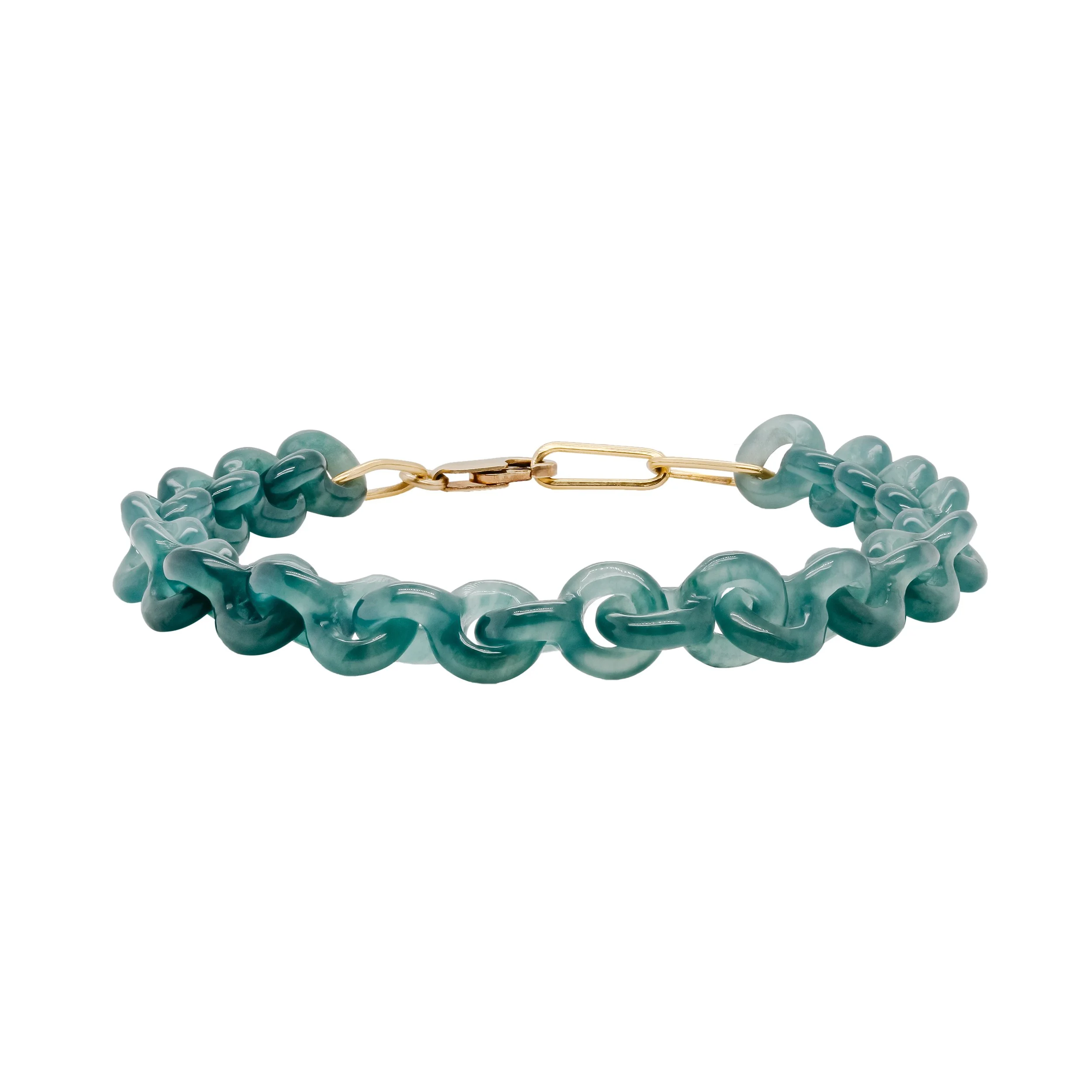
This bracelet is hand carved from a single piece of natural, untreated blue jade. It can be made solid as one piece to slide over the hand or with a paperclip chain and lobster clasp.
Made to order.
Collector’s Note: Guatemalan Blue Jade
Guatemalan blue jade isn’t just a gemstone—it’s a cultural treasure. This rare jade was sacred to the Indigenous Maya, who valued it more than gold. The stone was used in royal regalia, ceremonial offerings, and carved into symbols of power and spirituality. Blue jade signified life, breath, and the connection between earth and the divine. For centuries, the exact source of this jade was lost, remembered only in oral histories and archaeological artifacts. It wasn’t rediscovered until the 20th century in the Motagua Valley of Guatemala, where small-scale mining continues today. The blue color is completely natural—never dyed or enhanced—and ranges from soft sky blue to deep stormy tones. To collectors, Guatemalan blue jade carries more than beauty; it carries lineage, reverence, and a direct link to an Indigenous culture that prized it not for commerce, but for meaning.
Jade Treatments: What You Need to Know
Treatment is one of the most important factors in jade’s value, and it’s also one of the least understood.
In the gem industry, jade is classified into three main categories.
Type A jade is natural. It has not been dyed or chemically altered and may only be lightly waxed. This is the highest quality and most collectible form.
Type B jade has been chemically bleached and then filled with polymer to improve clarity. It may look attractive at first, but the process weakens the stone and reduces long-term value.
Type C jade has been dyed to enhance or change color. The color often fades over time, and this is considered the lowest quality.
Unfortunately, many treated jades are sold without clear disclosure. That’s why provenance and professional evaluation matter so much.
Guatemalan Jade and the Rise of Icy Blue
One of the most exciting developments in recent years has been the growing interest in Guatemalan jadeite.
Unlike many other sources, Guatemalan jade is naturally occurring and typically not chemically treated. It is not dyed or polymer-filled, which means it is essentially Type A jade by default.
This makes it especially appealing to clients who care about authenticity and longevity.
Guatemalan jade is known for its soft blue to blue-green tones, high translucency, and clean internal structure. The “icy blue” material in particular has become highly sought-after for modern jewelry designs.
We’ve seen a steady increase in requests for this look, and we’re sourcing more of it to meet that demand. It pairs beautifully with white gold, platinum, and diamonds, offering a fresh, contemporary feel while still honoring tradition.
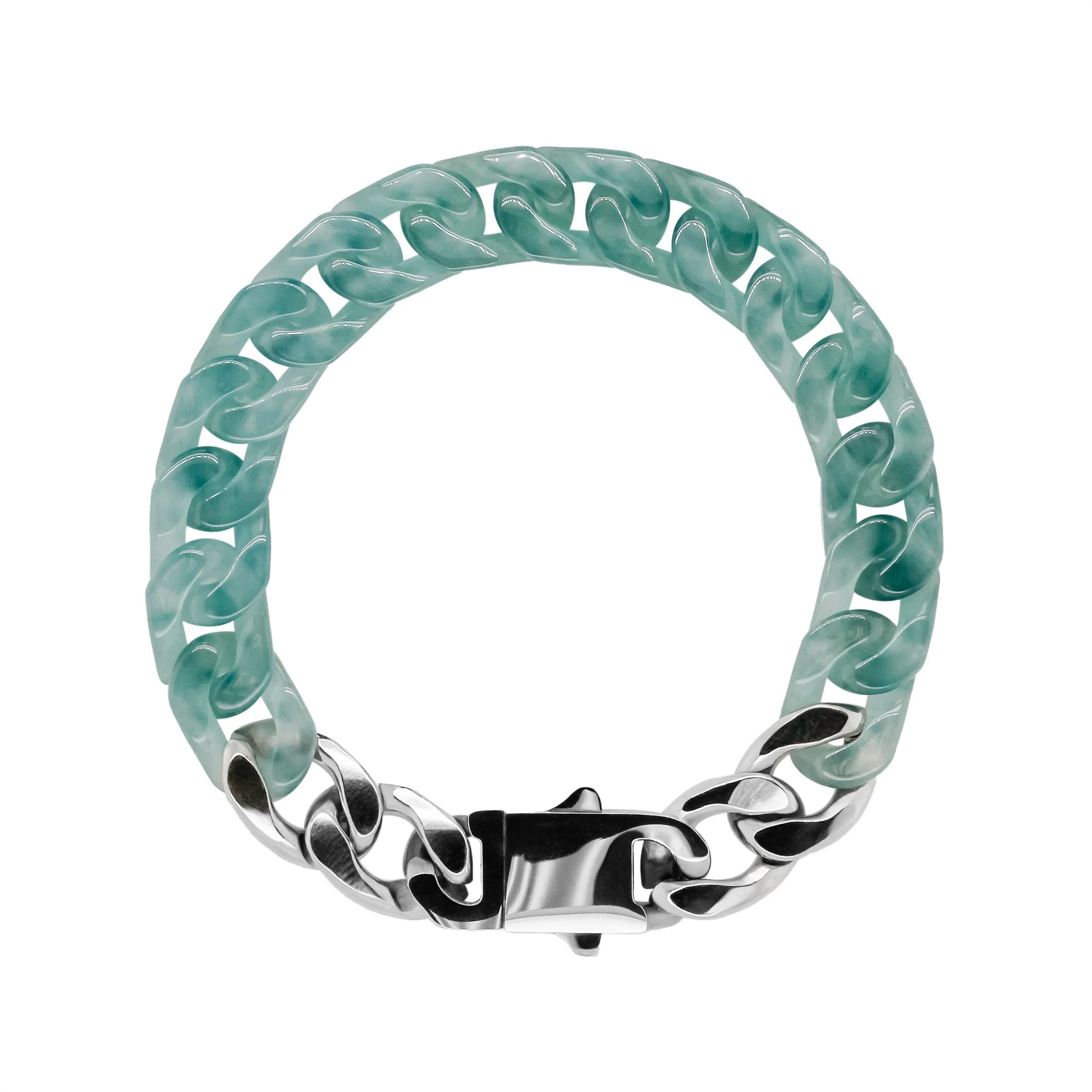
Made from natural untreated hand carved blue jade from Ecuador this bracelet is 11mm wide and 8” long. Comes with 5 extra links for sizing. The clasp and final two links are made from polished stainless steel.
Collector’s Note: Guatemalan Blue Jade
Guatemalan blue jade isn’t just a gemstone—it’s a cultural treasure. This rare jade was sacred to the Indigenous Maya, who valued it more than gold. The stone was used in royal regalia, ceremonial offerings, and carved into symbols of power and spirituality. Blue jade signified life, breath, and the connection between earth and the divine. For centuries, the exact source of this jade was lost, remembered only in oral histories and archaeological artifacts. It wasn’t rediscovered until the 20th century in the Motagua Valley of Guatemala, where small-scale mining continues today. The blue color is completely natural—never dyed or enhanced—and ranges from soft sky blue to deep stormy tones. To collectors, Guatemalan blue jade carries more than beauty; it carries lineage, reverence, and a direct link to an Indigenous culture that prized it not for commerce, but for meaning.
What About California Jade?
Many people are surprised to learn that jade is also found in California.
California jade is typically nephrite and was historically used by Indigenous cultures and early settlers. It is most often found along the coast and in riverbeds, especially in Northern California.
While California jade is meaningful and collectible, it is usually more opaque and less translucent than fine jadeite. It rarely reaches the value levels of top Burmese or Guatemalan material, but it remains an important part of American gem history.
How to Tell If Jade Is High Quality
When evaluating jade, size matters far less than quality.
Color should be natural and evenly distributed, without muddy patches or harsh dye lines. The best jade looks alive, not painted.
Transparency is another key factor. Higher-quality jade often has an internal glow. Terms like “icy,” “glassy,” and “translucent” are good signs.
Texture matters as well. Fine jade feels smooth and dense. Coarse, grainy material is less desirable.
And finally, treatment status is critical. Untreated jade is always more valuable.
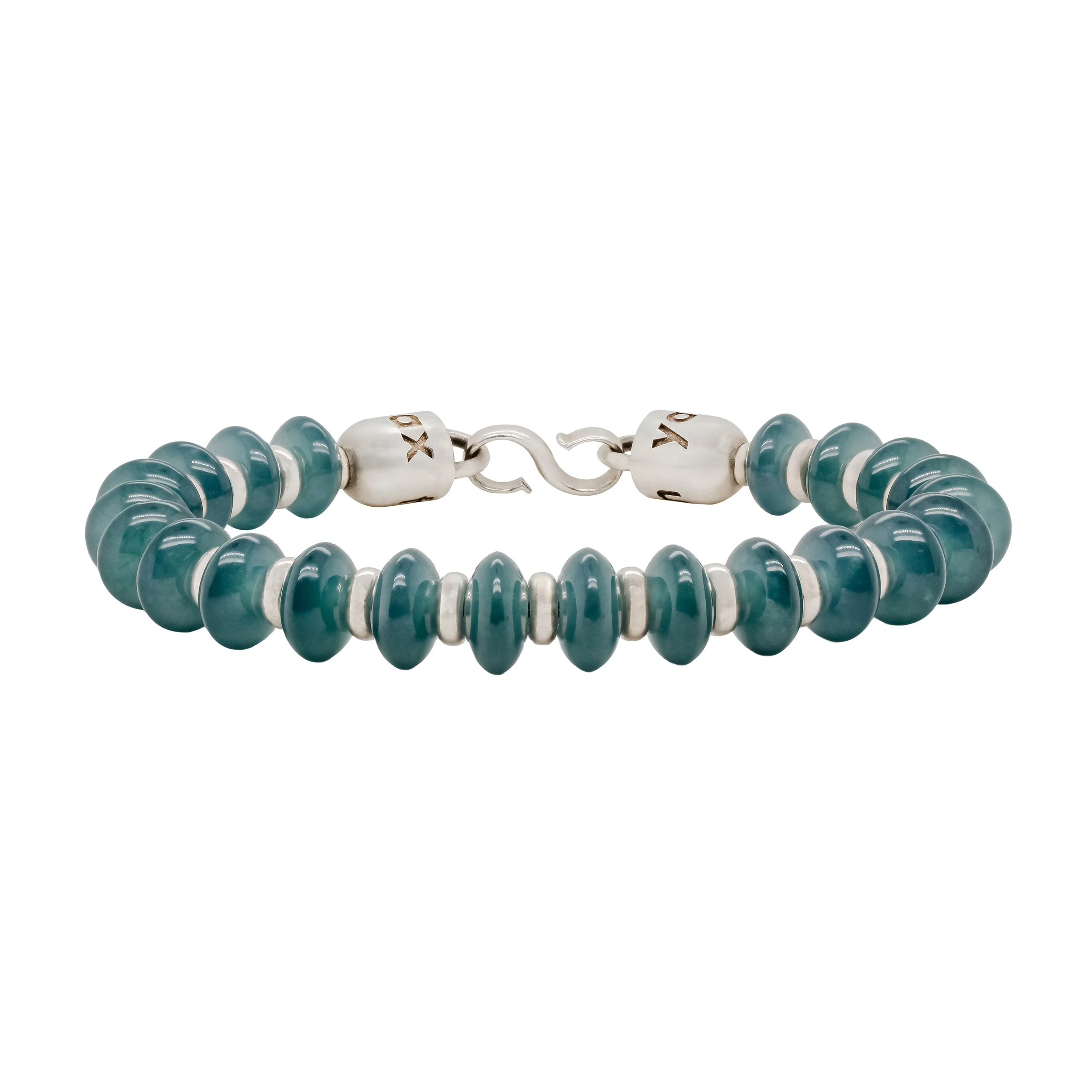
Made from natural, untreated, 10.5mm blue jade beads. The jade is accented by 6.75mm sterling silver beads and sterling silver s hook clasp. 9 ½ inches in length.
Collector’s Note: Guatemalan Blue Jade
Guatemalan blue jade isn’t just a gemstone—it’s a cultural treasure. This rare jade was sacred to the Indigenous Maya, who valued it more than gold. The stone was used in royal regalia, ceremonial offerings, and carved into symbols of power and spirituality. Blue jade signified life, breath, and the connection between earth and the divine. For centuries, the exact source of this jade was lost, remembered only in oral histories and archaeological artifacts. It wasn’t rediscovered until the 20th century in the Motagua Valley of Guatemala, where small-scale mining continues today. The blue color is completely natural—never dyed or enhanced—and ranges from soft sky blue to deep stormy tones. To collectors, Guatemalan blue jade carries more than beauty; it carries lineage, reverence, and a direct link to an Indigenous culture that prized it not for commerce, but for meaning.
Jade, Gold, and the Conquistadors
In ancient Mesoamerica, jade was often more valuable than gold—especially to the Maya.
To them, jade represented life, breath, water, renewal, and the divine. Gold was decorative. Jade was spiritual.
When Spanish conquistadors from Spain arrived in Central America in the 1500s, they were focused entirely on gold. Indigenous communities quickly realized this and began hiding their jade.
They buried it, concealed it, and passed it down quietly. As a result, much of the finest ancient jade never entered European hands and remained hidden for centuries.
Even today, archaeologists continue to uncover jade artifacts that were deliberately concealed during the conquest.
Historically, jade really was prized above gold.
“If Your Jade Breaks, It Saved You”
One of the most enduring jade beliefs comes from Chinese tradition.
There is a saying:
“When jade breaks, it has taken the blow for you.”
Many believe that when a jade piece cracks or breaks, it has absorbed negative energy or protected its wearer from harm. Because of this, broken jade is rarely repaired. Instead, it is often buried, wrapped, or respectfully set aside.
Replacing it is seen as beginning a new chapter.
Coincidence? Perhaps. But the belief remains deeply rooted.
Jade as a “Living Stone”
Across cultures, jade is often considered a living stone.
Collectors frequently say their jade looks better now than when they bought it. Part of that is due to polish and wear—but tradition holds that jade bonds with its wearer.
In symbolic thinking, dull jade may reflect exhaustion or imbalance, while bright jade suggests harmony and health.
It’s not scientific, but it speaks to jade’s emotional importance.
How to Care for Jade
One of jade’s greatest strengths is its toughness, but that doesn’t mean it’s indestructible.
Jade should be cleaned with mild soap, warm water, and a soft cloth. Avoid ultrasonic cleaners, steamers, and harsh chemicals, especially on treated stones.
Store jade separately from harder gemstones like diamonds to prevent scratching.
It’s also wise to remove jade jewelry when doing heavy work, exercising, gardening, or cleaning with chemicals.
When It’s Not Safe to Wear Jade
Despite its durability, jade can crack under the wrong conditions.
Avoid wearing jade:
During intense physical activity
When lifting heavy objects
In saunas or extreme heat
While using strong cleaning agents
When traveling if it’s a high-value heirloom piece
Jade is tough—but it is not meant to absorb repeated impacts.
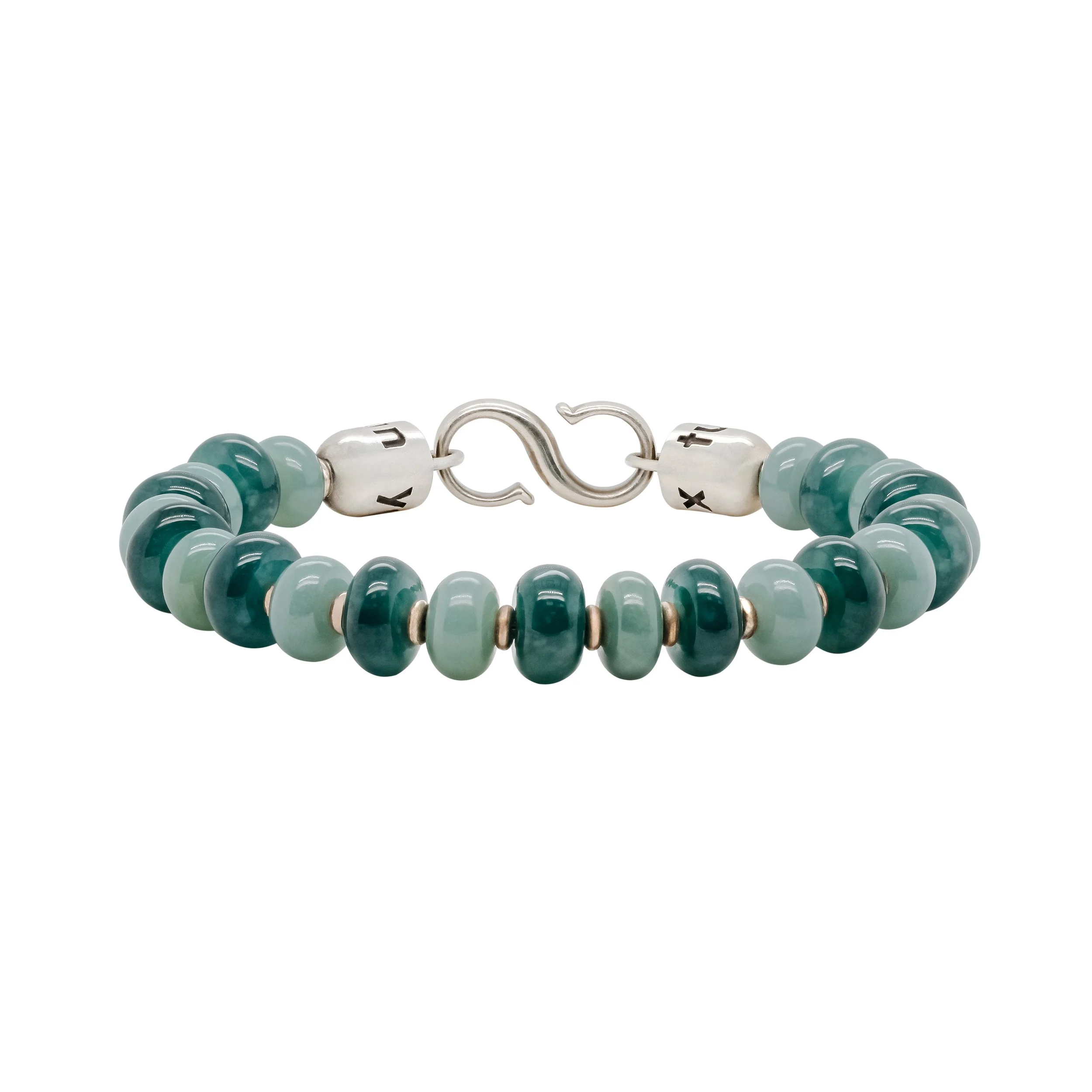
Made from natural, untreated blue jade beads measuring 9.2 mm and 8.2 mm in an alternating light and dark pattern. Accented with sterling silver beads and finished with a sterling silver S-hook clasp. Measures 7 inches in length.
Collector’s Note: Guatemalan Blue Jade
Guatemalan blue jade isn’t just a gemstone—it’s a cultural treasure. This rare jade was sacred to the Indigenous Maya, who valued it more than gold. The stone was used in royal regalia, ceremonial offerings, and carved into symbols of power and spirituality. Blue jade signified life, breath, and the connection between earth and the divine. For centuries, the exact source of this jade was lost, remembered only in oral histories and archaeological artifacts. It wasn’t rediscovered until the 20th century in the Motagua Valley of Guatemala, where small-scale mining continues today. The blue color is completely natural—never dyed or enhanced—and ranges from soft sky blue to deep stormy tones. To collectors, Guatemalan blue jade carries more than beauty; it carries lineage, reverence, and a direct link to an Indigenous culture that prized it not for commerce, but for meaning.
Folklore, Luck, and Protection
Across Asia and Central America, jade is still worn as a symbol of luck, health, protection, and family blessing.
It is often gifted to newborns, brides, and loved ones at major life milestones. Some families believe jade should never be purchased for oneself, only received as a gift.
These traditions continue today.
Why Jade Still Matters
In a world full of mass-produced, heavily treated gemstones, jade stands apart. As you’ve read, jade moves slowly through history, it carries meaning, and connects generations.
Especially with untreated sources like Guatemalan jade, we’re seeing renewed appreciation for stones that are honest, natural, and lasting.